Dosage and administration

Please follow the dosing instructions carefully.

Sucraid®
4-Day Trial

See if Sucraid® is right for your patients diagnosed with sucrase deficiency caused by Congenital Sucrase-Isomaltase Deficiency (CSID).

The recommended Sucraid® dose is based on one’s body weight

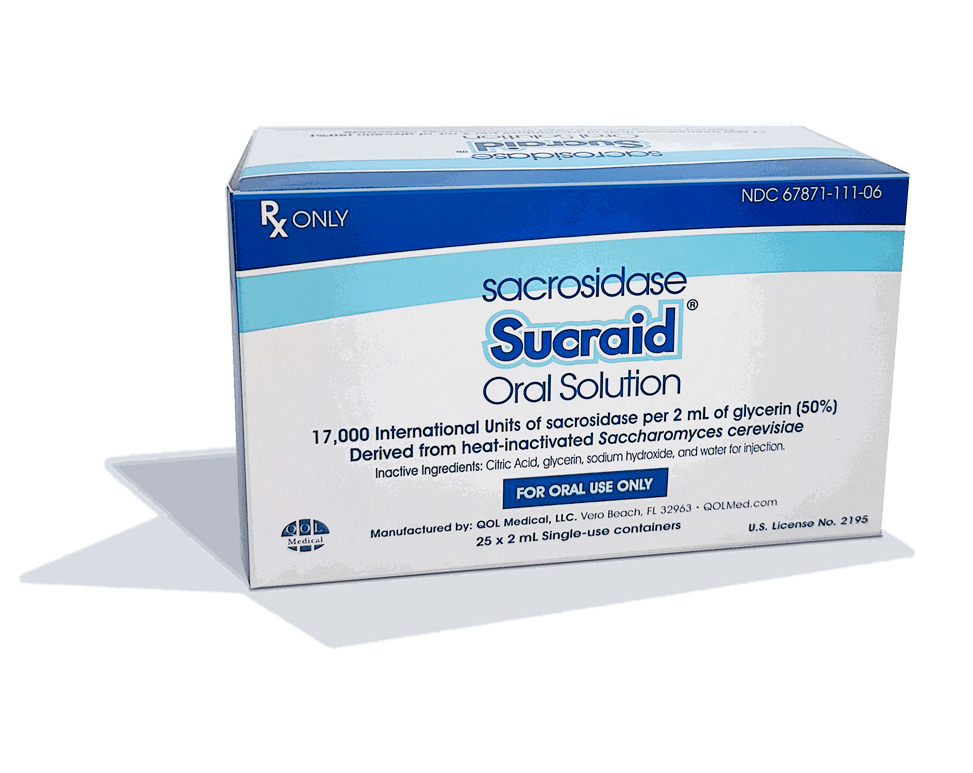
Sucraid® available in single-use containers that each hold a 2-mL dose.

The proper Sucraid® dose depends on the patient’s body weight.

  • For individuals who weigh up to 33 lb (15 kg), the Sucraid® dose is 1 mL
  • For individuals who weigh more than 33 lb (15 kg), the Sucraid® dose is 2 mL

Dosing instructions for Sucraid® single-use containers:

The contents of the Sucraid® 2-mL single-use container should be diluted in 4 ounces of water, milk, or infant formula. Patients should consume:

  • all of the mixed solution dose per meal or snack for patients over 33 lb (15 kg) in body weight
  • half of the mixed solution dose per meal or snack for patients 33 lb (15 kg) and less

Administration, 
storage, and shelf life

The following should be noted with regard to the administration:

  • Half of each dose should be taken before the meal and the other half during the meal
  • The beverage or infant formula used to dilute Sucraid® should not be heated, nor should Sucraid® be added to hot beverages, as heat can decrease the potency of the enzyme
  • Sucraid® should not be reconstituted or consumed with fruit juices, as the acidity may impair enzyme activity
  • For patients 33 lb (15 kg) and less, the second half of the mixed solution should be refrigerated and discarded if not used within 24 hours

Storage and shelf life of Sucraid®:

  • Sucraid® should be refrigerated at 36°F to 46°F (2°C to 8°C) and protected from heat and light
  • Single-use containers of Sucraid® can be removed from refrigeration and stored at 15°C to 25°C (59°F to 77°F) for up to 3 days (72 hours)

Healthcare professionals may recommend that patients avoid dietary sources of starch for the first two weeks of Sucraid® treatment, then gradually add starch back into the diet while monitoring symptoms, as Sucraid® does not address isomaltase deficiency.

Specialty
pharmacy

Learn how to order Sucraid®
from the specialty pharmacy.

Important Safety Information for Sucraid® (sacrosidase) Oral Solution
Indication

Sucraid® (sacrosidase) Oral Solution is indicated for the treatment of sucrase deficiency, which is part of congenital sucrase-isomaltase deficiency (CSID), in adult and pediatric patients 5 months of age and older.

Contraindication

Sucraid® is contraindicated in patients known to be hypersensitive to yeast, yeast products, glycerin (glycerol), or papain.

Warnings, Precautions, and Additional Important Safety Information
  • Severe Hypersensitivity Reactions
    Severe hypersensitivity reactions, including wheezing, difficulty breathing, rash, pruritis, and swelling of the face, lips, mouth, or tongue have been reported with administration of Sucraid®. Sucraid® contains papain, which is associated with hypersensitivity reactions.
  • Increased Blood Glucose Concentration in Patients With Diabetes Mellitus
    Sucraid® enables the products of sucrose hydrolysis, glucose and fructose, to be absorbed and may increase blood glucose concentrations. Monitor blood glucose concentrations and adjust the diet accordingly for patients with diabetes mellitus.
  • Dietary Starch Restriction
    Sucraid® does not replace isomaltase. Therefore, patients may still experience symptoms of CSID while taking Sucraid®. Consider dietary starch restriction in addition to Sucraid®, especially in patients in whom symptoms are not adequately controlled by Sucraid®.
  • Adverse reactions as a result of taking Sucraid® may include worse abdominal pain, vomiting, nausea, diarrhea, constipation, difficulty sleeping, headache, nervousness, and dehydration.
  • The effects of Sucraid® have not been evaluated in patients with secondary (acquired) disaccharidase deficiency.
  • DO NOT HEAT SOLUTIONS CONTAINING SUCRAID®. Do not put Sucraid® in warm or hot fluids. Do not reconstitute or consume Sucraid® with fruit juice since the acidity of the juice may reduce the enzyme activity of Sucraid®. Half of the reconstituted Sucraid® should be taken at the beginning of the meal or snack and the other half during the meal or snack.
  • Sucraid® should be refrigerated at 36°F-46°F (2°C-8°C) and should be protected from heat and light; single-use containers can be removed from refrigeration and stored at 59°F-77°F (15°C-25°C) for up to 3 days (72 hours). Refer to Instructions for Use for full information on how to take Sucraid®.

You are encouraged to report negative side effects of prescription drugs to the FDA. Visit www.FDA.gov/medwatch or call 1-800-FDA-1088.

IMPORTANT SAFETY INFORMATION:

Important Safety Information for Sucraid® (sacrosidase) Oral Solution

Indication

Sucraid® (sacrosidase) Oral Solution is indicated for the treatment of sucrase deficiency, which is part of congenital sucrase-isomaltase deficiency (CSID), in adult and pediatric patients 5 months of age and older.

Contraindication

Sucraid® is contraindicated in patients known to be hypersensitive to yeast, yeast products, glycerin (glycerol), or papain.

Warnings, Precautions, and Additional Important Safety Information

  • Severe Hypersensitivity Reactions
    Severe hypersensitivity reactions, including wheezing, difficulty breathing, rash, pruritis, and swelling of the face, lips, mouth, or tongue have been reported with administration of Sucraid®. Sucraid® contains papain, which is associated with hypersensitivity reactions.
  • Increased Blood Glucose Concentration in Patients With Diabetes Mellitus
    Sucraid® enables the products of sucrose hydrolysis, glucose and fructose, to be absorbed and may increase blood glucose concentrations. Monitor blood glucose concentrations and adjust the diet accordingly for patients with diabetes mellitus.
  • Dietary Starch Restriction
    Sucraid® does not replace isomaltase. Therefore, patients may still experience symptoms of CSID while taking Sucraid®. Consider dietary starch restriction in addition to Sucraid®, especially in patients in whom symptoms are not adequately controlled by Sucraid®.
  • Adverse reactions as a result of taking Sucraid® may include worse abdominal pain, vomiting, nausea, diarrhea, constipation, difficulty sleeping, headache, nervousness, and dehydration.
  • The effects of Sucraid® have not been evaluated in patients with secondary (acquired) disaccharidase deficiency.
  • DO NOT HEAT SOLUTIONS CONTAINING SUCRAID®. Do not put Sucraid® in warm or hot fluids. Do not reconstitute or consume Sucraid® with fruit juice since the acidity of the juice may reduce the enzyme activity of Sucraid®. Half of the reconstituted Sucraid® should be taken at the beginning of the meal or snack and the other half during the meal or snack.
  • Sucraid® should be refrigerated at 36°F-46°F (2°C-8°C) and should be protected from heat and light; single-use containers can be removed from refrigeration and stored at 59°F-77°F (15°C-25°C) for up to 3 days (72 hours). Refer to Instructions for Use for full information on how to take Sucraid®.

You are encouraged to report negative side effects of prescription drugs to the FDA. Visit www.FDA.gov/medwatch or call 1-800-FDA-1088.

Coming soon.